Our Research in the Media

Petris Center Blog Post published in Health Affairs

On June 26. 2019, Health Affairs published a blog post written by Steve Shortell, Richard Scheffler, Shivi Anand, and Daniel Arnold. The post highlights California’s experience with integrated delivery systems—specifically, integrated care model physician organizations; provides new evidence on their ability to provide lower-cost, higher-quality, value-based care; and, proposes a plan by which a state could expand such models to meet the needs of increasing numbers of people who would gain access to care under universal coverage. 

To read the full post, click here.

Statement of the American Medical Association to the California Department of Insurance

The American Medical Association (AMA) appreciates the opportunity to provide our views regarding the proposed merger of CVS Health Corporation (CVS), the largest retail pharmacy chain and specialty pharmacy in the United States and one of the two largest pharmacy benefit managers (PBM), and Aetna, Inc. (Aetna) the third largest U.S. health insurer. We commend the California Department of Insurance (the Department) for scrutinizing this massive proposed merger and the potential negative impact it poses to Californian health care consumers.

The full statement is linked here

Petris Center analysis part of AMA Report regarding Aetna-CVS Merger

The American Medical Association (AMA) addressed the U.S. Department of Justice (DOJ) regarding the Aetna-CVS merger, using research from Professor Scheffler and the Petris Center:

This merger is popularly described as vertical when, in fact, horizontal concerns are also substantial. Aetna and CVS compete in the Stand-Alone Medicare Part D Prescription Drug Plan (PDP) market that covers 25 million people nationally. Whether this merger of rivals in the PDP market runs an appreciable risk of substantially lessening competition is easily determined by a straightforward application of the DOJ and Federal Trade Commission (FTC) 2010 Horizontal Merger Guidelines (Merger Guidelines). University of California, Berkeley, health economics professor Richard Scheffler, PhD, has done that analysis. He finds that under the Merger Guidelines, in all but four of the 34 PDP regional markets, this merger would either be “presumed to be likely to enhance market power” or would “potentially raise significant competitive concerns and often warrant scrutiny.” Professor Scheffler concludes that this merger would raise PDP premiums in markets across the country, including California.

The full report is linked here

The Impact of Aetna’s Proposed Medicare Part D Stand-Alone Prescription Drug Plan Divestiture to WellCare

May 31, 2019
by Richard M. Scheffler

The purpose of this testimony is twofold. First, I will provide background information on the Medicare Part D stand-alone prescription drug plan (PDP) market and present recent market concentration trends. Second, I will demonstrate how Aetna’s proposed divestiture of its PDPs to WellCare would increase PDP market concentration.

*This paper was revised and reposted on June 17, 2019

Dr. Scheffler quoted in New York Times article underscoring the cost of private insurance

An article published in the New York Times on May 9, 2019 cited a recent RAND study that found a glaring discrepancy between the cost of care for Medicare and private health insurance groups. On average, private insurance payed 2.4 times more than the federal program for the same hospital services. Given that nearly a third of healthcare spending can be attributed to hospital care, it stands to reason that aiming to reduce the cost of private care to at least the Medicare level is a compelling vision. Politically speaking, this finding brings merit to the Medicare-for-All vision for the future, notably touted by Senator Bernie Sanders.

Further, Dr. Scheffler was quoted in the article, commenting that “market forces are clearly not working,” identifying the hospital consolidation as a factor contributing to the divergence between public and private insurer hospital prices. Given the rapid consolidation of hospitals and physician groups, nationally and in California specifically, it remains apparent that antitrust enforcement has faltered. Moreover, it is largely agreed upon by health economists that consolidation contributes to higher insurance premiums and hospital prices, with little gains in efficiency or quality of care.

While these findings point to a larger inequity in price distribution and a lack of transparency for consumers, it is relevant that hospitals often note that Medicare payments are enough for the hospitals to keep their doors open. Thus, the extra costs for private insurance are not frivolous as they are necessary to pay the bills and keep doctors employed. Ultimately, this points to a larger picture of a nationally broken hospital system, illuminating the need for large-scale change in the near future.


To read the full article, click here.

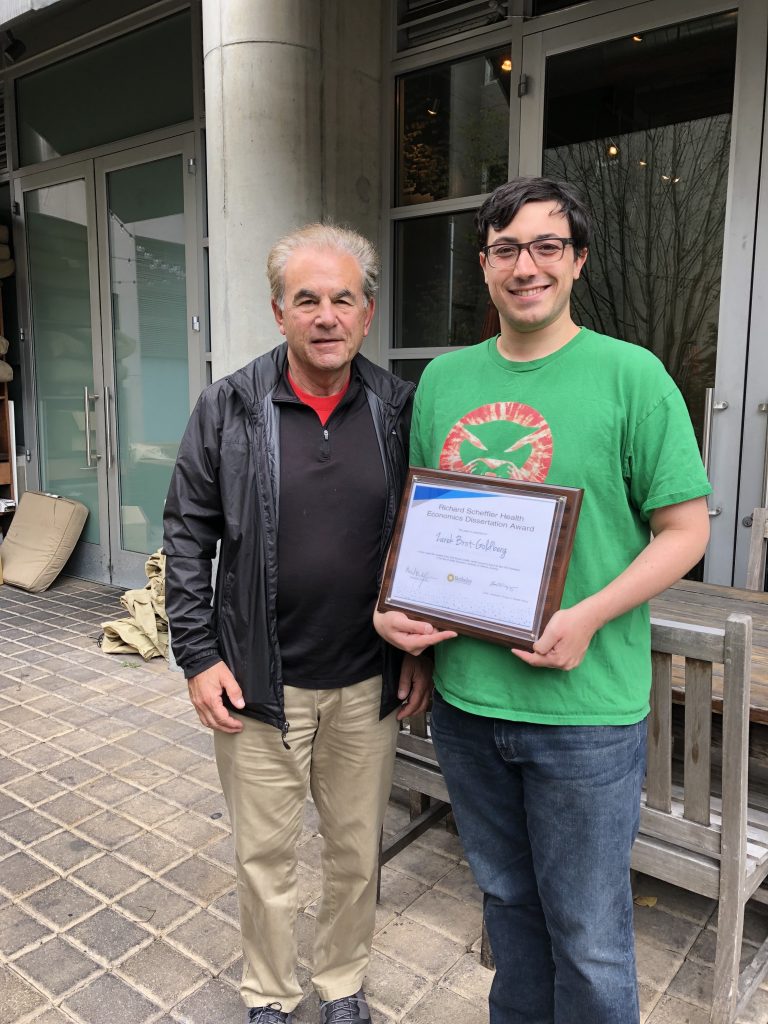
Zarek Brot-Goldberg awarded the 2019 Richard M. Scheffler Prize in Health Economics

Zarek Brot-Goldberg is the recipient of this year’s Richard M. Scheffler Prize in Health Economics. He is being recognized for his PhD thesis in health economics. During the 2019-2020 academic year, he will be a postdoctoral associate at the Tobin Center for Economic Policy at Yale. The following year, he will be an assistant professor at the Harris School of Public Policy at the University of Chicago.

Please consider making a tax-deductible contribution to the Scheffler Health Economics Award Fund, as this award will be a tribute to Dr. Scheffler for his many contributions to Berkeley and will enable the PhD program to highlight the research excellence in health economics and policy. If you are able to contribute to the dissertation award fund, please either mail a check to University of California, Berkeley Foundation and note “The Scheffler Health Economics Award Fund” or you can click here to be directed to the secure donation website.

Professor Richard Scheffler presents as part of a UC Berkeley panel on anxiety disorder

Professor Scheffler spoke about a recent study finding an increase in anxiety disorder among college students. He presented these findings as part of “A Generation Under Pressure: Talking Mental Health at UC Berkeley,” an event hosted by the Berkeley Institute for the Future of Young Americans as part of the Goldman School of Public Policy on April 18th.

Professor Richard Scheffler Interviewed on KCBS

On April 20th, Professor Scheffler was interviewed on KCBS Radio regarding a recent study describing the dramatic uptick in anxiety disorder among millennials. The study found the increase in anxiety disorder to be associated with financial strain and increased screen time on social networks.

To listen to the interview, click here

Petris Center Study Featured in San Francisco Chronicle

A study describing the rise of anxiety disorder in college students was highlighted in the San Francisco Chronicle on April 18th. The Petris Center study found that increasing rates of anxiety are correlated with increased tech and social media use, as well as financial struggles. Anxiety has grown faster than other mental health problems, such as depression. In 2016, 1 in 5 students on campus were diagnosed with anxiety disorder, with only 1 in 10 in 2008. This study points to an urgency to address anxiety in millennials, on campus and off.

To read the article, click here